Get an estimate in 60 seconds. No email required.
Agriculture explainer videos help farmers and consumers understand practices, technology and seasonal work. These 6 examples cover a recycling practice, farm data, targeted spraying, ag-tech education, a training module and a community program.
 Larry Mutenda
| Which agriculture explainer videos are worth studying? Six stand out, each for a different audience. Dairy Farmers of Canada answers a consumer question, CropX explains farm data, John Deere explains targeted spraying, Western Growers introduces ag-tech, AgriFutures teaches technology planning and South Australia’s Cosi visits farms. |
An agriculture explainer video is a short video that explains a farm practice, a piece of farm technology or an agricultural program. The audience may be a consumer buying food, a farmer comparing equipment or an agency supporting both. Each needs a different level of detail.
Farm technology becomes concrete when it is tied to irrigation, weeds, harvest work or reporting. The examples below run from a one-question consumer clip to a course module and a field visit.
Each video does a different job: a consumer answer, an ag-tech product, equipment technology, farmer education, a training module and community information.
The Dairy Farmers of Canada video comes from the Creamy Animation video library. The other five are published on each organization’s own YouTube channel and were available when we checked them on 28 November 2026. We describe each video from its own content and its published description. We credit any figures to the organization that published them.
Here is a quick overview of the 6 videos in this article. The table links to each example below.
| # | Company | Use |
|---|---|---|
| 1 | Dairy Farmers of Canada | Consumer question |
| 2 | CropX | Ag-tech product |
| 3 | John Deere | Equipment technology |
| 4 | Western Growers | Farmer education |
| 5 | AgriFutures Australia | Training module |
| 6 | Primary Industries and Regions SA | Community information |
Animated answer about plastic recycling on dairy farms
Runtime: 0:25
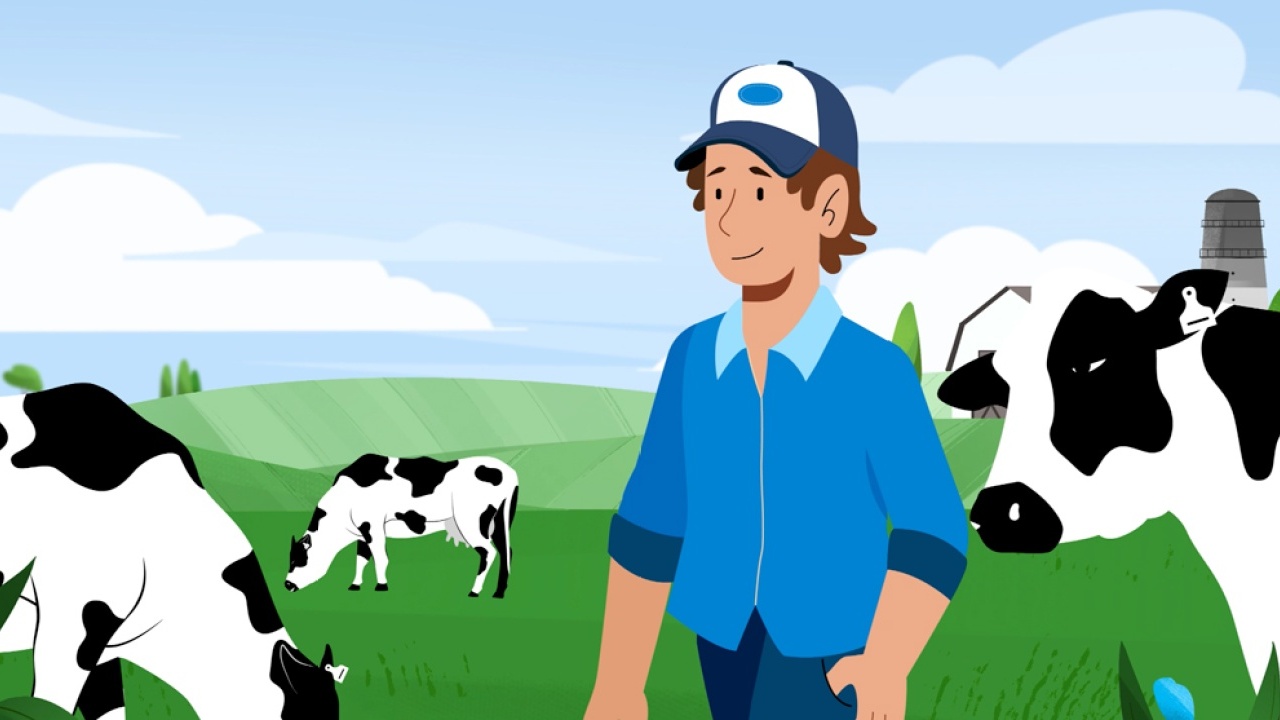
Dairy Farmers of Canada asks what Canadian dairy farmers are doing to recycle plastic with Cleanfarms. The video answers with the phrase every step they can, then names specific activities. It mentions recycling silage bags and bale wrap and compacting plastic on the farm so trips to collection sites are more efficient. It does not expand into a broad account of the dairy industry. The viewer is a consumer learning about one practice. It runs 25 seconds and is a 2D animation.
Why it works:
Takeaway:
Pair one narrow question with specific examples, not an industry-wide claim.
The Dairy Farmers of Canada video comes from the Creamy Animation video library.

Animated product explainer for a farm management system
Runtime: 2:03
CropX Explainer Video was published in October 2023. Its description calls it an animation of how the CropX agronomic farm management system collects data from soil to sky and turns it into actionable insights. A farmer who hears that a system collects data needs to know what the data supports in the operation. The video links the information to farm management tasks, so the product reads as a system with a place in farming and not as one more data source. It is a technical product aimed at people weighing its role in management.
Why it works:
Takeaway:
Name the decisions the data supports instead of a general digital-farming promise.
The video is published on the YouTube channel of CropX.
Theory of operation for a targeted sprayer
Runtime: 2:59
John Deere published See & Spray Ultimate Theory of Operation in June 2022. Its description says the sprayer is factory installed and distinguishes crops from weeds using advanced cameras, so that farmers can reduce herbicide use. The video is a theory of operation. It explains how the machine works and answers the questions a farmer asks about it in order. A complex machine is easier to follow when the explanation follows the buyer’s own questions. Check John Deere’s current product pages for the latest details.
Why it works:
Takeaway:
Break a complex machine into the questions a farmer asks, in order.
The video is published on the YouTube channel of John Deere.
Introduction to ag-tech in Yuma
Runtime: 1:08
Ag-Tech 101 was published by Western Growers in March 2025 as part of its Yuma Ag-Tech Series. Its description says Yuma farmers are using AI-powered machines to zap weeds, precision irrigation to save water and automation for other work. A farmer who meets several technology categories wants to connect them to real farm tasks. Abstract terms can hide the difference between weeding, irrigation and harvesting. Concrete uses give the introduction something recognizable. At 1:08 it is a compact field-focused account.
Why it works:
Takeaway:
Introduce the application before expecting engagement with a technology category.
The video is published on the YouTube channel of Western Growers.
First module of a farm technology planning course
Runtime: 4:21
AgriFutures Australia published Module 1, Farm Tech Planning – Why digitise agriculture? in June 2025. Its description says the module focuses on demystifying technology language and building foundational skills to promote technology adoption in agriculture. A farmer starting technology planning meets unfamiliar terms before deciding what might fit the operation. A first module can set the vocabulary and the reason for the subject. It does not need to perform every later planning task. Its role differs from CropX’s product introduction.
Why it works:
Takeaway:
Use the first module to set vocabulary and purpose, not to recommend a tool.
The video is published on the YouTube channel of AgriFutures Australia.
Public information video on agricultural technology
Runtime: 3:51
South Aussie with Cosi – Agriculture Technology (AgTech) was published in June 2026 by the South Australian Department of Primary Industries and Regions. Its description says Cosi discovers how agricultural technology is transforming the way farmers work across South Australia, from smart sensors to automated systems and more. A public audience hears about ag-tech without knowing what sensors or automation mean on a farm. Visiting real farms gives those terms a setting. It sits between public awareness and farmer education.
Why it works:
Takeaway:
Ground technical terms in farm activity, not abstract categories.
The video is published on the YouTube channel of the Department of Primary Industries and Regions.
A consumer video can focus on one question about a practice. A farmer considering a change may need conditions, steps and a clearer account of how the idea fits the operation. The difference is the information needed for the decision.
Dairy Farmers of Canada stays with plastic recycling practices. Do not stretch that scope into an implementation guide. Use a separate resource when the audience needs to plan equipment, timing or a working process.
Give a short consumer piece a narrow promise. It can say what a named practice involves without claiming to cover every environmental or operational question around it. The specificity is the lesson.
For a farmer-facing piece, list the information the farmer needs before acting. A broad introduction can establish relevance while a separate lesson handles the task. Do not stretch a short awareness video until it is too crowded for consumers and still too general for the farmers expected to use it.
Start with the farming task and the decision the technology supports. Explain what information or action the tool adds. Do not treat digital terms as proof that a product will suit every operation.
Respect the audience’s expertise. A farmer may know the operational problem well and the proposed technology not at all. Begin from what they know and define the new part clearly, instead of describing the farm back to the person who runs it.
CropX and Western Growers show two ways to make the connection. CropX links collected data to management tasks. Western Growers names applications such as weeding and irrigation in a farm setting. Ask which relationship your audience still needs: what information the system provides, or how a category of technology relates to their work.
Name the questions that still need assessment for a particular operation. The video can make those questions easier to ask. It should not imply that a broad promise settles suitability everywhere.
Choose a consumer practice question or a farmer’s technology decision. Dairy Farmers of Canada’s short recycling message does not teach ag-tech. CropX and the AgriFutures module sit at different levels of technical learning.
Start from farmers’ knowledge of their own work. Define new technology through irrigation, weeding, harvest tasks or reporting. Public audiences may need basic context about what those applications mean on a farm.
Separate described practices from measured outcomes and sector projections. Attribute any estimate to its source. Do not turn a national opportunity figure into a prediction for the farmer watching.
Use animation when data relationships or seasonal stages are hard to film together. Use farm footage when the real setting is central. Keep the place and the time frame clear so the video does not imply universal conditions.
Put farmer lessons on a learning path and short consumer messages beside practice information. Keep long presentations apart from compact introductions so the audience can see the commitment before they choose.
These are Creamy’s general ranges for a custom 60-second explainer video. They are not mining-specific quotes. The cost calculator on this page gives an estimate for your own brief.
| Production tier | Typical cost |
|---|---|
| Freelancer | $1,000 to $5,000 |
| Professional studio, fully custom | $5,000 to $10,000 |
| Premium studio | $10,000 to $25,000 |
| Enterprise | $30,000 to $70,000+ |
Animation shows data flows and seasonal stages that are hard to film together. CropX uses it to show data from soil to sky. Film the farm when the real setting is the point.
Start with the farm task and the decision the technology supports. Western Growers begins with weeding and irrigation. Then name the questions that still need assessment on a particular farm.
Consumers, farmers and agencies. Dairy Farmers of Canada speaks to consumers, John Deere to equipment buyers and the South Australian Cosi video to a wider public.
Name the specific practices and avoid claims about a whole industry. Dairy Farmers of Canada names silage bags, bale wrap and on-farm compacting. Attribute any figure to its source.
The videos here run from 25 seconds for a single question to more than four minutes for a course module. Match the length to what the audience must decide or learn.
We have no verified data on that. Put farmer lessons on a learning path and short consumer messages beside practice information, then measure where your own audience watches.
It is better to make two. Farmers want to know what the tool does for a task. Other audiences need different context. Name the audience in the title and the opening.
Creamy’s general ranges for a custom 60-second explainer are $5,000 to $10,000 for a professional studio and $10,000 to $25,000 for a premium studio. The budget step above has the full table, and the calculator on this page estimates your own brief.
Pick a real question from the audience and answer it with concrete detail. Dairy Farmers of Canada answers one, CropX and John Deere explain technology, Western Growers and AgriFutures teach and the South Australian video visits farms. Match the scope to the decision the viewer faces.


Larry is the founder and Chief Storyteller at Creamy Animation, founded in 2009. He leads a team that creates story-driven videos for businesses and nonprofits. 15+ years in video strategy and production, specializing in SaaS, B2B, and nonprofit storytelling. A marketer, designer, and animator, Larry has overseen the production of more than 1,500 videos for Fujitsu, Logitech, Warner Brothers, NFL, Blockdaemon, Astronomer, Canonical, and 370+ others.
For Larry, God is first, and everything else is a blessing that comes from serving Him. When he’s not working, he’s hanging out with his wife and three kids, playing the piano, or pursuing his filmmaking side hustle.
Need pricing for your next project?
We'll calculate a pricing range for your project in less than 60 seconds.
Get Your Estimate!